
A brush with asphalt, a fleeting flash between stationary bodies: the scooter no longer just crosses the city, it challenges it. Everyone is now trying to ride faster than the traffic jam, escape the overcrowded subway, and invent their own route along the thread of urban mobility. But choosing the right ride in 2025 feels more like a balancing act than a walk in the park.
This year, acquiring a scooter is no longer yielding to a passing trend. It’s confronting an avalanche of models, standards that change as quickly as traffic lights, and expectations that leave no room for approximation. Between autonomy, safety, and design, the buyer must exercise discernment. At every street corner, urban dwellers embark on a hunt for the ideal companion, one that will allow them to traverse sidewalks and tame the urban jungle without compromise.
Where is urban mobility in 2025? Trends, challenges, and new needs
Look around you: Paris, Lyon, or Bordeaux buzz with the rhythm of electric wheels. Urban mobility has transformed, and the electric scooter has conquered the city. It’s no longer just a gadget: it’s the ally of those who want to outsmart traffic jams and bus schedules. Uses have become clearer: the most compact models appeal to hurried commuters, the all-terrain attracts explorers of peripheral neighborhoods, and the multimodal delights those who juggle between subway and pavement.
But freedom has its limits. Regulation now sets the tempo:
- Speed limited to 25 km/h
- 14 years old to take the handlebars
- Brake, bell, front and rear lights: every detail counts, and wearing a helmet becomes the unspoken norm
- Approval and CE certification mandatory to ride in the city
- Civil liability insurance: non-negotiable
Some municipalities go further: wild parking has no place, only marked areas allow for a stop. Goodbye anarchy, hello order on the sidewalks.
Expectations have also sharpened. Reliability, autonomy (from 20 to 40 km for most daily trips), comfort (shock absorbers, generous deck, well-designed handlebars), and safety make the difference. And, of course, price remains a decisive factor: the range is wide, and the cost of a model or service varies from simple to triple. To navigate this, it’s relevant to consult references such as the price of Dott in the comparison “Dott vs Tier: which scooter service is the cheapest in 2025? – Travel Destination.”
Manufacturers are anticipating the future: seamless connection to mobile apps, more efficient batteries, refurbished models to limit ecological impact, simplified maintenance… Urban mobility no longer just moves us; it invites itself into an ecosystem where every innovation shapes daily life.
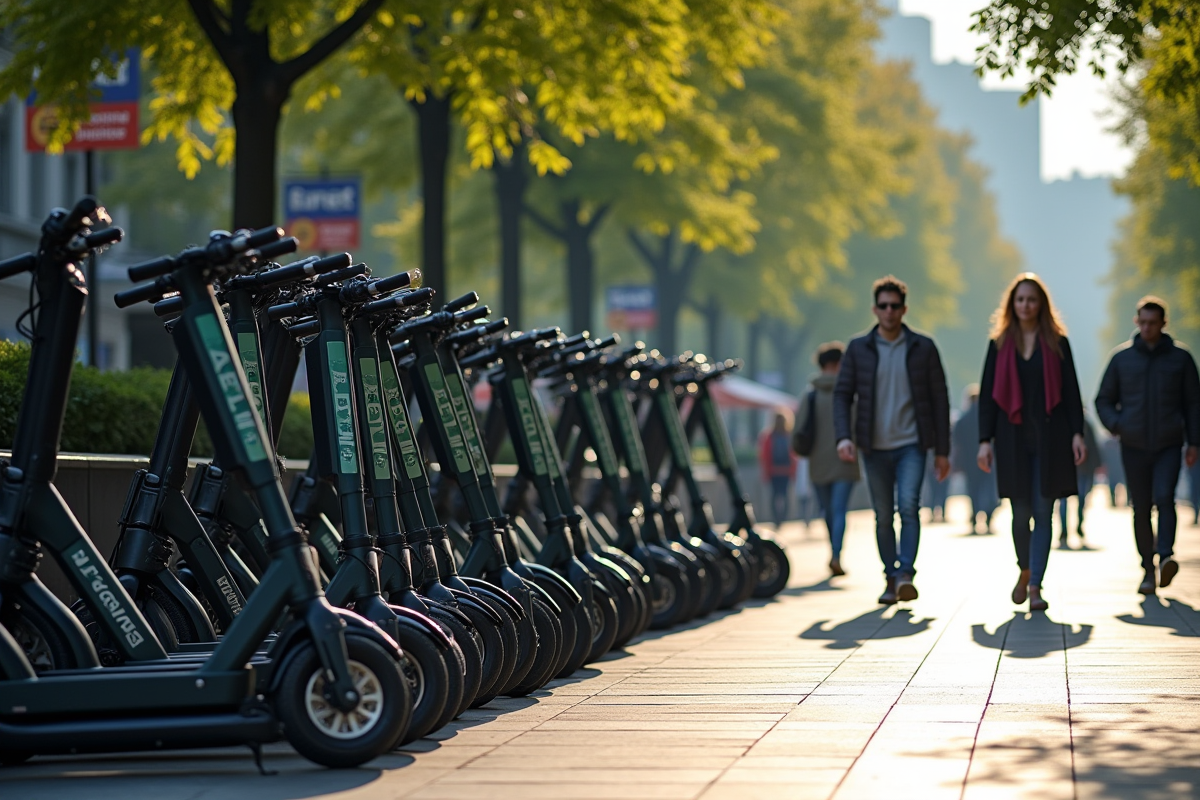
Which scooter to choose based on usage and innovations to watch this year
Tailoring your choice to daily use
Urban use: aim for lightness, between 7 and 15 kg, and a folding design to fit into the subway without cluttering the platform. An autonomy of 20 to 40 km is sufficient to cover most daily trips, while a minimum 350 W motor ensures quick starts at green lights.Multimodal use: focus on quick folding, a well-thought-out carrying handle, and a weight not exceeding 12 kg.All-terrain use: here, robustness is key. Opt for dual suspension, 10 to 12-inch knobby tires, and a motor exceeding 500 W to tackle both urban cobblestones and rugged paths.
Key technical criteria
- Battery: prioritize lithium-ion, with capacity matching your typical trips.
- Brakes: disc or drum, regenerative braking adds an extra layer of safety.
- Comfort: wide deck, ergonomic handlebars, front and rear suspensions to smooth out city bumps.
- Tires: solid for peace of mind, inflatable to absorb shocks.
Innovations to watch in 2025
The companion app becomes essential: it informs about battery status, allows you to lock your scooter remotely, or locate it in a blink. Refurbished models are on the rise, offering a warranty of 6 to 12 months and an economical alternative. In terms of safety, intelligent braking is making its debut, along with connected accessories — helmets with integrated indicators, GPS locks. The support of a responsive after-sales service, the availability of spare parts, and the simplicity of maintenance weigh heavily in the decision to buy a scooter. In an era where every detail counts, choosing your scooter is already shaping the city of tomorrow.