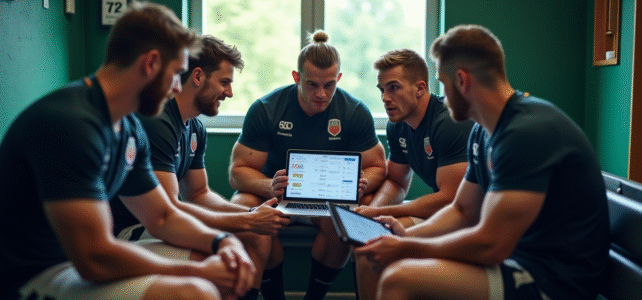
A hooker who puts down a winger from 30 meters, that’s no longer a tall tale. This is the kind of surprise that today’s ocean of rugby statistics has in store for us. Rugby enthusiasts delight in these kinds of anomalies, half-fascinated, half-skeptical, in front of the cold hard numbers that shake our certainties about the game.
The hunt for data is no longer the exclusive domain of analysts tucked away in the stands. Now, anyone can dissect a player’s profile, compare performances, or trace the thread of their exploits. A new frontier is fading: passion and expertise intersect, and every action on the field becomes a chapter to decipher.
Statistics, the new compass of modern rugby
Today, rugby is no longer just told through big shoulder tackles and bravery. Statistics have taken over: they unite coaches, sports geeks, and enthusiasts from all walks of life. Gone are the days of naked-eye judgments. Now, morphology, weight/height ratio, running ability, and tackling capacity shape the identity of rugby players. Kévin Roberti, physical trainer at Saint-Priest Rugby, has understood this well: his study on the evolution of player physiques reveals forwards who are increasingly massive, a direct consequence of the professional era, the obsession with scrums, and ironclad defense.
Online platforms unveil, sheet by sheet, this diversity of talent. A hooker must combine speed, agility, and a taste for combat; the prop, a monument of power, remains the first line of defense. The numbers speak: tackles, meters gained, tries, cards – everything is included. Matches in the Champions Cup, Top 14, or Six Nations Tournament turn into open-air laboratories, where every gesture is dissected.
For those who want to go further, three angles of analysis are authoritative:
- Individual statistics: tries, conversions, penalties, drops, time spent on the field.
- Collective statistics: points scored, possession, discipline (yellow and red cards).
- Morphotype: comparison of physiques, according to position or competition.
One cannot overlook the reference: Allrugby. This treasure trove of rugby data offers detailed profiles, from the Top 14 to Pro D2, including the biggest international contests. You can track the evolution of players like Felix Lambey, second row for LOU Rugby, or the unshakeable Antoine Dupont, conductor of French rugby.

Where to find comprehensive and reliable player profiles?
To truly explore player profiles, it’s best to rely on a platform that doesn’t cut corners. Among enthusiasts and analysts, the demand is clear: precise individual statistics (tries, conversions, tackles, minutes played), the complete trajectory of a player, their morphotype, their history, and career milestones.
On www.1jour.net, the database provides detailed profiles, from the Top 14 to Pro D2, not to mention major global competitions. You can follow the journey of stars as well as emerging talents, from the young player shaking up the hierarchy to the seasoned player accumulating seasons. For each player, you can find:
- Biographical data: age, height, weight, club, position played
- Seasonal performances: tries, points, cards, matches played
- Club history: transfers, past seasons, individual awards
This platform goes further: it offers a fine reading of positions. Take a prop: their weight/height ratio dwarfs that of a scrum-half. The entire front row – props and hooker – occupies a strategic position in the scrum and defense, and it only takes a few clicks to access this valuable information.
This attention to detail meets a growing need for precision and understanding. Coaches in the Top 14, like Ugo Mola in Toulouse, scrutinize this data to build their lineups and anticipate matchups. Rugby has never been so transparent, nor so fascinating. Lines of statistics have transformed into stories in their own right. Who would have believed, twenty years ago, that the secret to a victory might be hidden in a column of numbers?