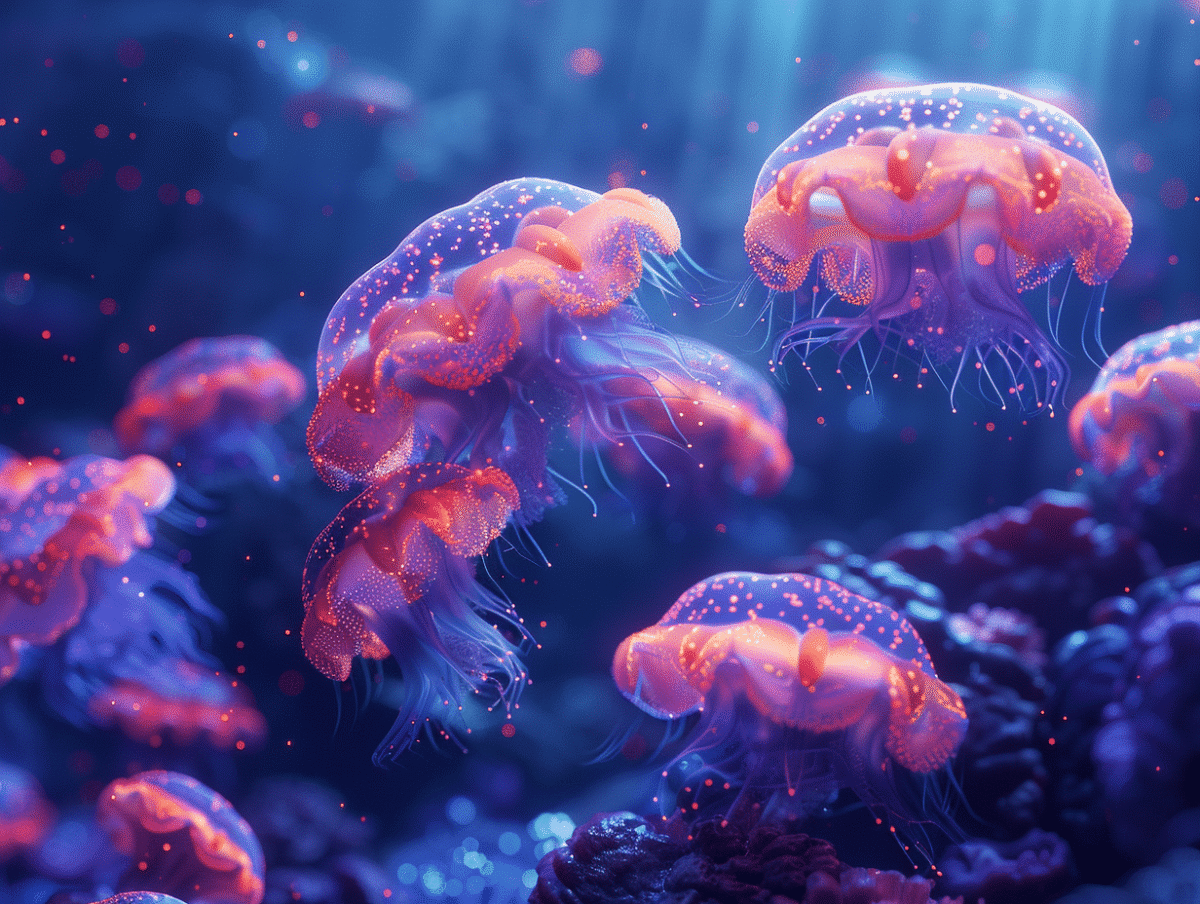
The oceanic abyss, this dark and unfathomable world, harbors a biodiversity that is as fascinating as it is strange. Scientists venture into these unexplored depths, revealing life forms that defy imagination. These creatures, often unknown to the general public, have adapted to the extreme conditions of their habitat: colossal pressures, absence of light, freezing temperatures. Their very existence challenges what we know about life on Earth and paves the way for new biological discoveries. From translucent-bodied fish to luminescent invertebrates, each specimen reveals a little more of the mysteries of the ocean floor.
Exploration of the Abyss: Discovering Unknown Species
The exploration of the oceanic abyss resembles the conquest of a parallel universe, where the common rules of biology and physics seem to be overturned. Scientists, armed with cutting-edge technologies, dive into the midnight zones and hadal zones, where sunlight does not reach. At depths of 1000 meters, these inaccessible regions conceal species with exceptional adaptive capabilities. Their often surprising discoveries expand the spectrum of known life and shape our understanding of evolution.
In the heart of this darkness, deep-sea predators, such as certain great white sharks, evolve at 1280 meters below the surface. These animals develop unique adaptations such as sharp teeth and luminescent systems to hunt in the dark. The discovery of complex trophic networks around these predators highlights the richness of these abyssal ecosystems, often mistakenly perceived as desert-like.
Scientists are also amazed by structures like the coral reefs located nearly 3000 meters deep, challenging preconceived notions about the resilience of life in extreme conditions. The slugfish, discovered in the Mariana Trench, embodies the ability of life to take root in the deepest waters of our planet. This habitat, which includes the famous Challenger Deep at 10995 meters below the surface, serves as a natural laboratory for studying the limits of life.
Among these astonishing creatures, the vampire crab attracts the attention of researchers. With its bulging eyes and disproportionate claws, it is a perfect example of the strangeness that characterizes abyssal fauna. The study of these marine organisms offers unprecedented insights into the evolutionary and genetic mechanisms that have allowed these animals to thrive in conditions hostile to most forms of terrestrial life. Science, by uncovering the secrets of the depths, demonstrates the resilience and ingenuity of life as a whole.
Extreme Adaptations: How Life Thrives in Total Darkness
In the impenetrable silence of the abyss, where total darkness reigns, life deploys adaptation strategies that defy imagination. The xenophyophores, for example, unicellular organisms observed at a depth of 10660 meters, illustrate the capacity of life to take root in extreme conditions. In these environments, each organism is a case study for scientists scrutinizing the mechanisms that allow them to withstand crushing pressures and the absence of light.
The hydrothermal vents, oases of heat in the ocean floor, provide another spectacular example of adaptation. The bacteria that thrive there, isolated from any source of sunlight, derive their energy from the minerals emitted by these underwater chimneys. These microorganisms, carriers of valuable genetic information, offer considerable potential for medical and technological applications. These vents are also hotspots for scientific research aimed at understanding the origins of life on Earth and designing innovative biotechnologies.
The mining of the deep sea, which aims to extract minerals from the ocean floor, raises major ethical and ecological questions. The cobalt-rich encrustations targeted by this extractive activity are essential to many marine organisms. At the same time, marine viruses pose a pervasive threat, to which isopods, among other deep-sea animals, have developed defenses. These complex interactions between marine organisms and their environment are crucial for understanding how life can not only survive but also thrive in the most hostile conditions on our planet.