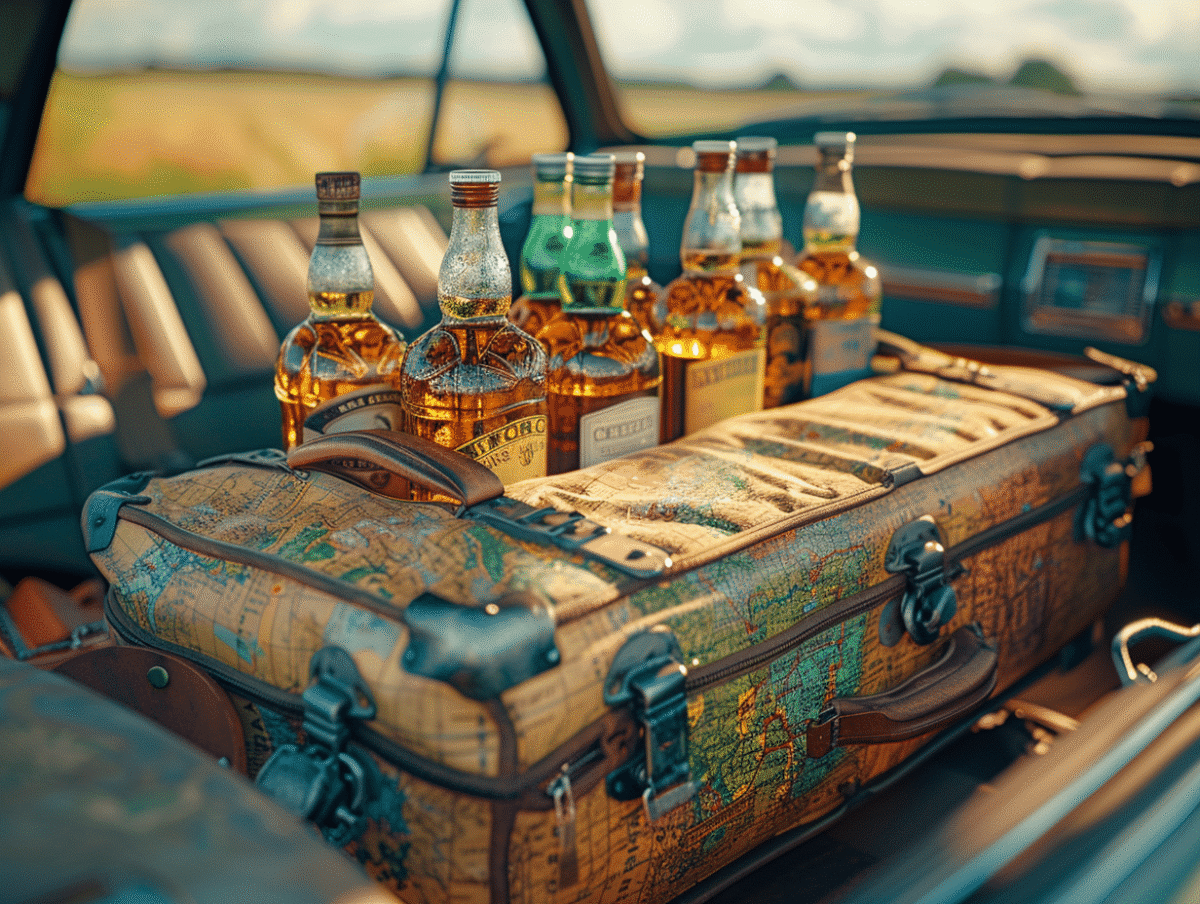
Taking the road in France with alcohol in your vehicle may seem trivial, especially after a trip to a wine region or following a night out with friends. There are specific rules governing the transport of alcoholic beverages. These regulations are in place to ensure road safety and prevent risky behaviors. It is essential to know the current legislation to avoid fines or legal troubles. Drivers must therefore be vigilant about the quantity transported, how it is done, and especially their own blood alcohol level when behind the wheel.
The rules for transporting alcohol in a car in France
Travelers opting for the road must remain aware of the restrictions surrounding the transport of alcohol in their vehicle. The alcohol transport limit car France is defined based on whether the goods come from the European Union or outside of it. A traveler can bring back for personal use without declaration up to 90 liters of wine (of which a maximum of 60 liters can be sparkling wine), 110 liters of beer, 10 liters of alcohol over 22°, and 20 liters of alcohol at or below 22° when traveling within the European Union. In contrast, the maximum quantities allowed for a trip from a non-EU country are limited to 4 liters of non-sparkling wine, 16 liters of beer, 1 liter of alcohol over 22°, or 2 liters of alcohol at or below 22°.
Border travelers are subject to even stricter rules, with quantities reduced to 0.5 liter of non-sparkling wine, 4 liters of beer, 0.25 liter of alcohol over 22°, and 0.5 liter of alcohol at or below 22°. These limits come with value allowances that differ based on the origin and mode of transport. EU travelers are not subject to value restrictions for personal use, while those arriving by air or sea from non-EU countries must adhere to a value allowance of €430 for those over 15 years old and €150 for those under 15 years old, with the amount decreasing for those traveling by land.
Beyond these quantities, the traveler must declare their goods to customs. Failure to declare or exceeding the established thresholds can lead to consequences such as the seizure of goods, fines, or even prison sentences. Vigilance is essential, and it is important to keep all receipts or proof that could attest to the legitimacy and compliance of purchases in case of a check.
The consequences of non-compliance with legislation
Failure to comply with the maximum allowed quantities for transporting alcohol in a car can lead to serious repercussions. The customs conducts thorough checks, and any irregularity discovered can result in a seizure of goods. This first consequence, already unfortunate for the offender, is often accompanied by financial penalties. Indeed, a fine proportional to the excess quantity and the nature of the products can be imposed on the spot.
Beyond monetary sanctions, more serious or repeated offenses risk leading to prison sentences. In such cases, the justice system is involved, and the traveler may be prosecuted for smuggling or illegal importation of goods. It is therefore imperative to strictly adhere to the established thresholds to avoid legal troubles.
For questions regarding transportable alcohol quantities and customs regulations, the Info Douane Service is available by calling 0 800 94 40 40. The agents provide accurate and tailored information for each situation, allowing travelers to comply with current legislation.
Holding a free circulation card can facilitate customs passage. This document, obtained from customs services, certifies the goods that the traveler has legally acquired in the European Union and is transporting with them. This card serves as additional proof in case of a check, thus simplifying the verification process by customs.